

Originally published in VoiceConnection.com · October 2005
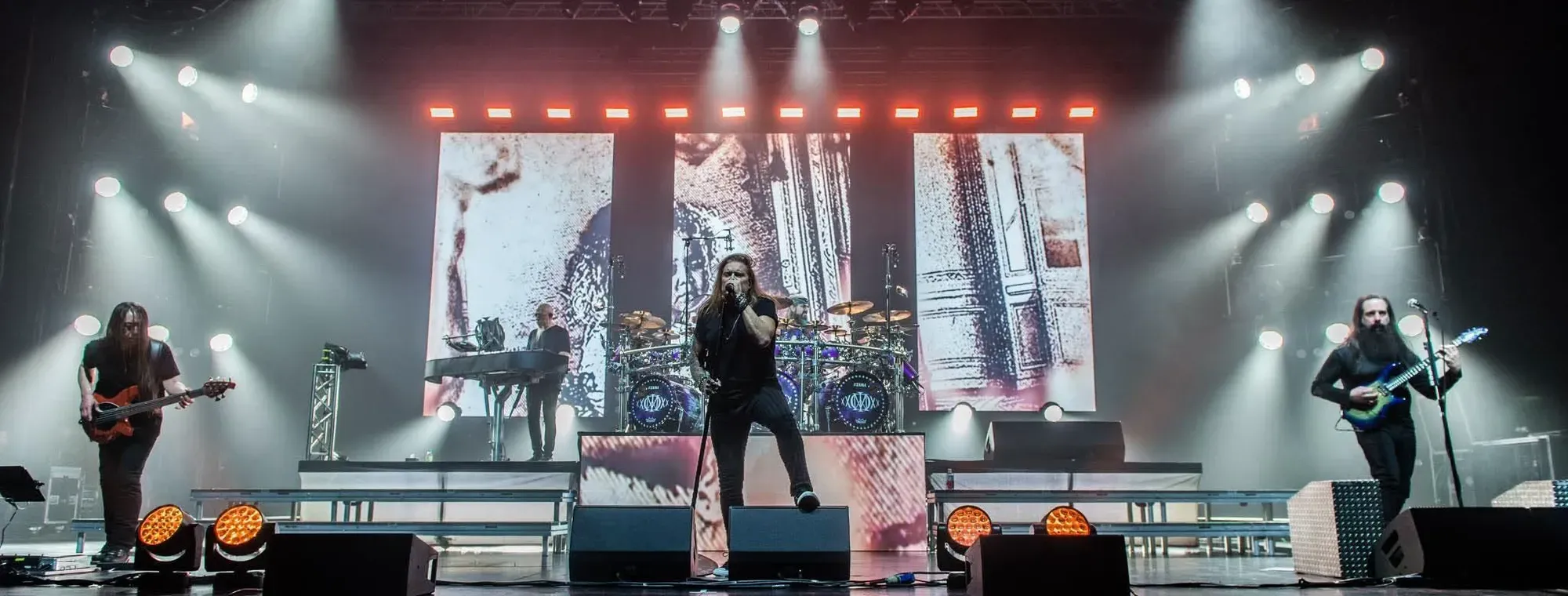
James LaBrie – Dream Theater
InterviewJames LaBrie20 min read
James LaBrie, the quintessential vocalist and legendary icon of world-renowned progressive rock group, Dream Theater, has returned with two simultaneous releases- Dream Theater’s, “Octavarium”, and Elements of Persuasion-James’ latest solo effort. With 10+ Dream Theater releases, 3 solo projects, and numerous guest vocalist appearances under his belt, James has amassed an enormous amount of vocal knowledge that would prove beneficial to all musical artists. From touring and songwriting tips, to rebuilding the voice that is known and loved by millions, LaBrie has a story to tell.
Although once suffering from ruptured vocal cords as a result of food poisoning from more than 10 years ago (that presented vocal obstacles for 8 years), LaBrie has refused to slow down or halt his musical career, when other singers would have completely given up. Now, Labrie is performing at what he considers to be the top of his game, and what I would consider, (from my recent Dream Theater concert as James’ guest), singing and performing, by far, at his best, as was apparent by his soaring range, powerful voice, and trademark sustain and vibrato. What does it take to conquer your voice and become a world-renowned vocalist? Let’s find out:
Jaime: Have you checked out the web site?
James: Yeah, but I didn’t go on because it was a sign in thing...
Jaime: It shouldn’t be. There’s an “Enter” at the bottom of the opening page. Did it have a picture of me leaning back and shattering a glass?
James: No, it kept saying ‘membership’ and started bringing me into that. I just went “argh.”
Jaime: I don’t know what’s going on. I’ll contact my web master and correct it. We are working on a “Members Only” section on the site, because we’re actually releasing the book again with 30+ new pages of material, over 60 “Useful Tips” and a new cover. That’s probably why the “sign in” page popped up. Here’s a copy of both of my books, plus a couple of CD’s for you to enjoy. I’ve got all of the “glass shattering” videos on here, but they’re VCD, so you should be able to use Windows Media Player.
James: All right. Or any DVD player, I’ll bet.
Jaime: I’ll get you a copy of the new book when it comes out.
James: I’ll bust this CD up on my laptop.
Jaime: I’ll get you a copy on DVD. It’s hard to break glasses. I HAVE done it. I just did an infomercial in Hollywood with Alex Trebek where I was required to perform my talent.
James: Who was the guy? (The guy who taught Vendera to shatter glass.) From what? Lita Ford?
Jaime: Yeah, you remember Lita Ford?
James: From Nitro?
Jaime: Yeah. You remember Jim Gillette? The real high-pitched singer who was famous for shattering wine glasses?
James: Yeah. Yeah. Yeah.
Jaime: Yeah. Actually, Jim, picked me to take his place for the Good Morning America show as a guest of Jamie Hyneman and Adam Savage of the Discovery Channel show, MythBusters. We used an amplifier for the show, and the MythBusters were like, “Man, your voice is so loud. We know you could do it without amplification, even though it’s never been proven.” And now, I should be in Guinness World Records next year.
Keith Gilbert: Have you seen the show Mythbusters?
James: No.
Jaime: That episode will be on the VCD I just gave you.
James: Oh, yeah. OK.
Keith Gilbert: He did that show...about three months ago?
Jaime: I did that back in February. So that’s what documented me as the first in the world and I’ve done it for other appearances... It’s just a concise thing. Although it’s hard to do, I think you could do it James. You have a great voice.
James: (laughs) Thanks, man. I’ll definitely check it out. You know, for many years there, like in ’94, my wife and I were down in Cuba and I had food poisoning while I was down there and became violently ill, like delirious, you know? I ruptured my vocal cords. I went and saw three ear, nose, and throat specialists. It wasn’t irreparable, but it wasn’t something they could go in and fix, like nodes, (which I’ve never had) and then, after surgery, three months later, you’re singing. They just said it was going to be a matter of time. “We don’t know how long it’s going to take. It could take a year, it could take six months?” It took eight years!
Jaime: Really?
James: About 2002, 2003, I felt everything start to come back into its place. Then I went back to studying with...
Jaime: Rosemary Patricia Burns?
James: No, that was a long time ago. Victoria Thompson. She studied in St. Louis... Got her majors down there-Her voice majors. Then for 20 years, she was in Europe and she was singing with the likes of Placido Domingo, Luciano Pavarotti, and many other big opera stars. She did that for twenty years. She lived in Germany, which was her main hub, and then she just kept filtering up, so... She retired three years ago and she moved back, right around my area.
So, I just happened... My daughter wants to take lessons, right? I said, “Well, fuck, a dad teaching his daughter. There’s no focus. It’s too easy for her to just... “Oh, come on, dad.”
So, I looked in the paper and saw this girl with all these credentials and I was like, “What? No way!” I called her up, talked with her for a bit, felt her out, then went and saw her. I was so impressed by her. I said, “Wait a minute? Want to get *me* back in there?” She goes, “Well, when is the last time?” And I said, “A while.” Then I gave her my history and she goes, “No problem. You can be with me for three weeks and you tell me if you’re not feeling it.”
Jaime: So what’s different? Is she teaching bell canto, or...? Or how are you approaching voice...?
James: It’s more like the mask.
Jaime: That’s what you need. (Especially for pure tone) You need to project into the mask...
James: Yeah. Some of it resonating through the bone structure. Right? Then a lot of focus, which I know you were saying something about that on your site. But the breathing is crucial...
Jaime: Yeah, for me, that’s how it is... pushing that resonance into the mask. (The front of the face, including the cheeks and sinuses). Then I’ve got to push straight down though, to keep the diaphragm from pushing up on the lungs. That’s how I broke my first glass. I really concentrated on resonance while pushing down and boom! And it exploded in my face.
James: (About Jaime shattering glasses.) I mean, ‘cause we (Dream Theater) were all like, “whoa.” To be honest with you, that’s why I sent you an email. I mean, I’m not gonna disclaim what you’re saying, but I mean we were all like going, “no fuckin’ way.”
Jaime: No. I tell you, I CAN do it! I broke one about two weeks ago. If you want to learn, I’ll send you a glass... I’ve got one in the car. They’re tough to break. These aren’t lead crystal glasses. They’re titanium crystal. They’re actually a harder glass. It’s a good thick glass, by a company called Schott Zwiesel. I dropped a glass once, and it bounced off a concrete floor and didn’t shatter.
James: What is it? Is it a certain frequency you have to hit?
Jaime: Yeah. I have broken them from a Tenor C, C sharp up to an Alto F.
James: Really? Wow! I can hit those notes.
Jaime: Yeah. I’m telling you. You could do it. But it’s a real heady tone. It’s not a pretty tone.
James: Is it more of a piercing sound?
Jaime: It’s a (makes a high, piercing tone). Kind of like that. Really loud. I get up so loud. It takes about 105 decibels to shatter a glass. I can get up to 120 decibels.
James: It’s not something that you’d want to put down on a track.
Keith Gilbert: Not every glass...(laughs)
Jaime: Unless you’re Judas Priest. (laughs)
James: Maybe Rob might appreciate it. (Ha-ha.)
Jaime: Yeah, I bet he would.
James: Go ahead with your questions so we can do it.
Jaime: Who were your influences when you first started singing?
James: Well, the biggest, and still is...Freddy Mercury. He was always amazing... My sister had Queen One and I remember just listening and saying, “Who is this?” You know? Just simply being taken by it and ever since then, it’s been everything they’ve ever released. I mean, you can go on my iPod here and I’ve got EVERYTHING by Queen.
So the other guy that impressed me was Robert Plant. I remember loving Robert Plant. John Anderson of Yes to a certain degree, just because I love his melodic structuring. Not so much his voice as his melody structuring. Then Steve Perry was very influential to me. I thought he was great.
Jaime: I’ve tried to get a hold of him.
James: I heard he’s a recluse.
Jaime: Steve Augeri, the new singer, has agreed to do an interview with me, but I’d still like to interview Perry.
James: I mean, I’m not taking anything away from the new singer, but he doesn’t have the same tonality as Perry.
Jaime: Yeah, there’s a difference.
James: Yeah. The resonance that Perry had. Although Perry doesn’t have that anymore.
Jaime: Yeah, I agree. His tone has dropped down into his throat and his range seems to have lowered. I know you’ve mentioned that you like Tony Harnell.
James: Yeah. Yeah. I know Tony.
Jaime: Well, yeah. To my knowledge, I’m the only vocal teacher he’s contacted to work with him on a new voice related training project. He’s wanting to develop a website to teach all over the world. So he’s working on it and we’re gonna set it up and you know...
James: He’s a great guy. Great vocalist. Amazing.
Jaime: Well, that’s what got me into you, really. I remember seeing a poster for “Images and Words” in Columbus, Ohio and I thought, “What a cool cover.” And I was like, “ahhh’, not interested”, but, then I heard the CD. There were certain nuances to your voice, like on “Metropolis Part One” that got my attention. Afterwards, I was like, “Man, he kind of reminds me of Tony Harnell.”
James: You should hear my older stuff before that, on Winter Rose. I was a lot higher. I think that JVC in Japan still has it. But it was released through Inside Out and JVC.
Jaime: I’d like to get a copy of it. I would really like to have it.
James: The only way is if you went on site and on JVC and see if they still have it.
Jaime: So... When you left Winter Rose and you joined Dream Theater, how did you vocally have to change?
James: I think it was just pretty apparent where I wanted to go vocally, because of the music... I don’t know how you go about it, but the music pretty much dictates where I want to go melodically. Melodically, once I’ve established that arrangement, then I pretty much know how I want to convey it, emotionally, and tonally. So I’m always like, no matter what I’m singing on, I’ve got to feel it first, musically and then feel how it’s moving me. Then it just automatically comes out of me.
Jaime: That reminds me of a question that Keith had... I know that the other members of Dream Theater write a lot of the lyrics. So, how are you working that? You know, like with Sebastian Bach, when he was in Skid Row... The other members of the band were writing all the lyrics. I’m sure he was frustrated. That’s probably why he left. So are the other members like, here are the lyrics, James, now you figure out the melody for us, please?
James: No. The melody always comes first. So it’s myself, Mike and John that are sitting down and we are constructing the vocal melodies for the songs. And then, once those are established, then we say, “Here, you take this song and you take this song.” And usually, it’s a song that I want to write the lyrics to. I’m really feeling something here and I want to write something and then it’s like, okay, I’ve got the song I want to write lyrics to. Usually, when I’m doing my solo stuff, I’m taking control over everything. It might be two or three lyrics that Matt will contribute or tend to. But on Elements of Persuasion, out of twelve songs, I might have penned nine.
Jaime: You know, I just got it last week and I’ve been so busy with the site, that I haven’t had a chance to listen to it much... Is it a concept album?
James: No. It’s concept in the fact that I’m touching upon subjects on how we are always constantly struggling with our mortality. I talk about things from an observational point. You know? Like what we’re seeing, every day, going on around the world. Talking about religious things, like, how we’re all affected by that. Whether we want to admit it or not, to a certain degree, it does kind of direct us on how we act and interact and react around one another. So there’s a lot of subjects that I’m talking about in there that people find informational.
Jaime: I really like the album. Take the first song, “Crucify”. I love it because it reminds me of Images and Words and your older albums, Personally, I like the pure tonality of your voice and I like it when you sing in your higher range.
James: Right.
Jaime: The tone is so pure and piercing. It’s a little different from Mullmuzzler. Especially different from Mullmuzzler 2, on which I feel there’s this almost Egyptian type and Zeppelin like feel.
James: Right. Right.
Jaime: I really like that feel.
James: And that’s what I went with it on Mullmuzzler 2. Like I said earlier on, Plant was very inspirational. But with Elements of Persuasion, I really wanted to show more of the metal edge. I wanted to show people that there’s a big appreciation for just hard-hitting, aggressive music. But that’s the only thing that comes around to. I mean four years, five years ago, I would have had a lot of problems singing like that. But once my voice recovered, (it just simply healed), and then going back to studying again, with Victoria getting me back into a zone where I could *feel* what she was trying to communicate- then you know what it’s like.
Jaime: How do you feel about breath support?
James: Once you get your breathing under control, if you have that support constantly, on a consistent basis, then you have to keep it. Because if you lose it at any point in the night, if you don’t have that support, your note is going to show it. Maybe to you, it’ll show it. To most people, it just flies by. If I’m watching a singer, no matter how good he is, I’ll kinda be able to tell what kind of support he has behind that. And how on the money he is.
Jaime: You know, on your Live at Budokan DVD, before the show, you’re walking around the hallway warming up. What is your process now, for warming up?
James: Well, my process now is basically clef scales. It’s very (humming). Starting off humming and then (Ahhhh). Just slowly bringing myself up to a point where I feel that I’m coming near my upper register. And it’s just a very slow process. It’s like over 40 minutes. So I might be doing some scales for like ten minutes and then I walk away. And then I’ll just simply be walking around (humming), really like nice, comfortable... (Jaime doing some humming and horse noises)... I do that, too. You know, up and down. And the other thing too, is I’m jogging three miles every day. That helps. I’m always stretching before a show.
Jaime: I’ve got a program in my book called Vocal Stress Release I developed because I had neck surgery and it’s all about stretching the neck, body, and...
James: Right.
Jaime: And stretching the diaphragm, and breathing...
James: Right. I mean, it’s really important. Cardiovascular strengthening, it’s unbelievable how much support you can get from that. It’s just made a world of difference for me.
Jaime: So, is there anything else you’re doing to care for your voice on the road?
James: Yeah. Absolutely. Like, I’ve got to the point that I’ll have in my bunk, two bottles of water like this. I’ll have one of them on one side... my left side.
Jaime: And one in the sink. (Points to sink in bus and laughs)
James: And one in the sink, (laughs) and one on my right side. The one on my right side, seriously... I’ll stick my finger in it and I’ll put some of the water in my nostrils to moisturize the inside of my nose, then I’ll go back to sleep.
Jaime: Let me tell you a really good tip. I sometimes use Entertainer’s Secret, a specialized throat spray, but you can use plain water for this. Get you a little one ounce water-misting bottle. You can breathe it into your mouth or you can squirt it up your nose. (Inhales deeply through nose) When you breathe in, it’s going down the trachea, so you can immediately coat the vocal cords. It’s not the pure lubricant that you’re developing through the mucus, but it does help to maintain the elasticity of the cords.
James: Well, that’s cool. The only thing I do, too, and you’ll notice it tonight, is, I have a thermos onstage and literally, I have very hot water and honey in the thermos. I came upon that myself one day when I was with Victoria and we were doing a lesson. I said, “You know, there’s no mistake about it. When I’m around, if it’s a humid area, I feel more relaxed, I feel more open. Everything just seems to flow out of me, as if I’m having a conversation.” She said, “Absolutely. Why don’t you find something that will bring you there and keep you there?” So I just started thinking about it? My wife and I will sit around and we’ll have hot water, like tea. Tea isn’t good for you.
Jaime: No. Caffeine isn’t good for a singer.
James: Tea strips you. That’s a big myth that people think. Tea and honey, right? So I thought, “Wait a minute. Hot water.” I was going to do my vocalese one day and I had a cup of hot water. I put a little dab of honey in it. I went down and did my vocalese and it was amazing. It just kept me open. So, I wanted to take that further. Now I constantly keep a thermos on stage with hot water and a little bit of honey in there and it just keeps going all night. Then when I’m backstage, while we’re doing an instrumental section and stretching it out, I have another thermos, and I’m doing it there as well. It just totally keeps me there. Everybody’s like, “What’s that thermos? What’s going on there?” It’s hot water and honey. And that’s what I’m using when I’m onstage. But that, even that process when I’m warming up and I’m doing my vocalese, it’s the same process. I have hot water and honey that I’m sipping while I’m doing my warm-ups.
The other thing I do is drink orange juice. I think this is very imperative. Vegetables. I’ll always eat vegetables. We’ll always have a vegetable tray back stage. Zinc. I take zinc. I’ll do a half a tablet before I go onstage. It’s usually a 50-milligram tablet. And I’ll do a half tablet in the middle of the show. If you do too much, you’ll get sick. You’ll literally feel nauseous.
Those things, (and a lot of sleep,) I find, are really imperative to helping me keep my voice.
Jaime: Have you had any vocal trouble though? Besides the food poisoning. I mean have you had to do anything like cortisone shots?
James: Ah... I think I’ve done that once. I’ve done that once, right? (Talking to tour manager) I did it once in Baltimore. I was screwed. I mean, you know, we *had* to do the show. If I don’t do the cortisone, there’s no way I’m going on. I had a sinus infection and the flu.
Jaime: Please don’t do it again.
James: Oh, no, I won’t. But I had a sinus infection. There was only one way getting around it unless I wanted to cancel the show. If I did that... I’ve talked to Klaus Mein, and he’s done it, several times..
Jaime: I know that a lot of the singers that I’ve interviewed have done it.
James: Have you ever done it?
Jaime: No. No. I’ll tell you, you know what’s really scary about it? You can practically do anything with your voice.
James: That’s what I’ve heard.
Jaime: You don’t feel a fuckin’ thing, man. I mean, literally, you feel *nothing*, and you talk to the doctor and he says, “Oh, yeah, you’ll be all right. You need a shot now and in an hour, you’ll be able to sing like a bird.” And you do. I mean, you walk in and you’re like (low gravelly mumbling). And you’re walking out and you’re going (high-pitched clear note). It’s unbelievable. You wouldn’t believe it. That’s what it is. It’s like what you say. It’s not a big thing.
James: You know, you’re breathy. You use a lot of breath.
Jaime: What I like about you is that you’re very breathy. I also like your vibrato. A lot of singers will go to, like, an ‘A’ vowel, instead of an ‘E’ vowel on higher notes. I notice that you’ll focus on that me sound when you sing, like this (singing ‘me’ in a waving tone). You’ll really use that ‘E’ vowel. Now, is that stylistic or is that something for you?
James: I got a lot of that from Freddie Mercury. If you think about Freddie- the way he expressed himself, and the way that he uses vibrato. His vibrato was sporadic. It was uncontrolled. It was just something that... It was almost like Jeff Buckley. I don’t know if you like Buckley.
Jaime: I love him.
James: Isn’t he amazing?
Jaime: Yes, he is. I’ve been trying to turn one of my students onto Buckley.
James: But he had control over a vibrato that some might interpret as just being wild. He wasn’t wild. That guy was just awesome.
Jaime: Have you ever listened to Alter Bridge?
James: Yes, Myles Kennedy.
Jaime: Myles called me awhile back and one of the first things I said to him was, “Do you like Jeff Buckley?” He said, “Yeah, I’m busted.” (Ha-ha.) Because, if you listen to him on the Mayfield Four recordings, he sounds so much like Buckley.
James: You know, Mark Tremonti was actually at our show in Orlando, and he’s a big fan, obviously of Petrucci’s. He was there and he was just loving it. He was saying the same thing. But I’m from an older school than what Myles would be. Because my influences were a little bit different than Myles’.
Jaime: And that’s sad. Well, that’s not sad, but out of all the new singers out today I really like his voice. I’m so glad that singers like that are coming back. But singers have kinda went away for a while.
James: Well, it’s almost like it’s un-cool to sing. A lot of metal heads, now, (and there are tons of them), are going “aaaggghhh” (low throaty growl). That’s all you’re hearing, with the exception of Symphony X.
Jaime: You know, I’ve never heard them until tonight. I have heard the name.
James: Oh, he’s great.
Jaime: I’m going to try to interview him (Russell Allen) tonight.
James: He’s great. He’s a really, really good vocalist. He’s very Dio-like, very much like (Ronnie James) Dio.
Jaime: Do you have any tips, tricks, or tactics that you care to share with singers who are aspiring to be like you?
Keith Gilbert: He told you about the hot water and honey.
James: Yeah, that’s a great tip...
Jaime: In the book, I mention twelve different ingredients that you can use, for a hot water mix.
James: That’s my biggest tip. And you were talking about Live at Budokan. Well, unfortunately I would have loved to have gone in and re-sang that whole fuckin’ thing, cause that was one of my worst nights on that whole tour, and it was like, “What do I do? Do I cheat? Do I go into the studio and re-do it? Do I just leave what it is and that’s it?”
Jaime: That’s the essence, though.
James: Yeah, I mean, it was really unfortunate, because, usually when a band does something like that, a three-hour show, you usually have a day off before. We were jamming the night before-We did the three-hour show the night before. It was just trying to fit things in. And to a vocalist, it’s just completely unfair. But anyways, whatever...
Jaime: One more question. The first thing I noticed on Octavarium is that it is so much more vocally inclined that the last few albums. I feel like Six Degrees of Inner Turbulence was more about a musical show.
James: Yeah.
Jaime: The last couple albums seemed more about the music. This release is more like Images and Words and Awake, which are two of my favorite albums. I feel like it’s because the band is focusing on you again, and as a vocalist, that’s what I want to hear.
James: Yeah, of course. Well, we’re writing more consciously aware. I think that as time goes on, we’re focusing more on song presentation and something that really grabs you and keeps you captivated, so to speak. And a way to do that in a massive way is the voice. The first thing that people relate to is the voice. They either love it or they hate it. And I know that some people dislike my voice, but that’s fine. I mean, everyone likes their own thing. It doesn’t matter. I don’t care. I’ve never let it affect me, since I know what I mean. I don’t care. If you don’t like me as a vocalist, go listen to someone else. It’s that simple. I don’t care.
But with this record, it was true that we were really focusing in on the melody presentation...How to make a really concrete statement, musically, as a whole.
Jaime: Yeah, because look... We know you guys can play.
James: Yeah, of course.
Jaime: We (the fans) want to see the total package... That’s what I like-an amazing vocalist behind this amazing band.
Keith Gilbert: I’m a drummer. I like Mike.
Jaime: (laughing)
James: (ha-ha) Yeah, of course. And we have it all, right? It’s like, somebody is into the keyboards, the guitarist, the drums, the voice... So it’s all around. But yeah, definitely this one has more focus on making it a really band-united effort to bring something that everyone could embrace.
Jaime: It’s a great album.
Keith Gilbert: Very good. Very good. Very good.